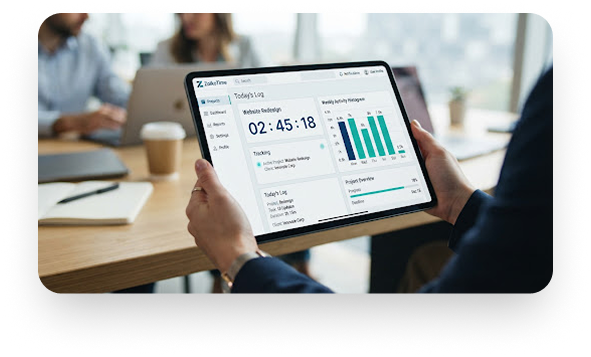
Know what happened. Pay, bill, and defend it with confidence.
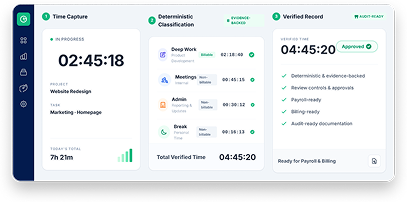
ZoikoTime creates deterministic, evidence-backed time records for payroll, billing, compliance, and audit, with screenshots, keystroke capture, or workforce surveillance.


Reduces payroll leakage
Eliminate ghost time and unverified hours.
.png)
Creates audit-ready records
Deterministic evidence for payroll and compliance.
.png)
Improves policy consistency
Consistent time rules across teams and regions.
.png)
Privacy by design
No screenshots. No keystrokes. No surveillance.
Distributed Work Increased Flexibility and Operational Risk
As teams became more distributed, many organizations lost consistent visibility into how time, access, and outcomes aligned with policy. The result is growing exposure across payroll, compliance, security, and audit.


Unverified Work Sessions
Leads to uncertainty in time data integrity and payroll accuracy.

Activity Inflation & Automation Noise
Creates misleading records and weakens trust in reported work.

Outcomes Masked by Activity Noise
Leaders lose visibility into what actually happened and what can be defended.

Conflict-of-Commitment Risk
Undisclosed parallel work can create legal, policy, and operational exposure.

Wage-and-Hour Exposure
Inconsistent time evidence increases compliance and dispute risk.

Security & Access Policy Drift
Distributed work can weaken control over identity, access, and policy alignment.
ZoikoTime addresses these risks without invasive monitoring, using deterministic classification, evidence-backed records, and human review.

From Verified Time Capture to Workforce Truth Infrastructure
ZoikoTime combines deterministic classification, evidence-backed records, and human review to help organizations manage distributed work with trust, compliance, and operational control.
- Distributed workforces at scale
- Regulated and audit-heavy environments
- Global payroll and contractor operations
- Teams requiring defensible records
Enterprise Modules
Modular capabilities that work together to deliver trust, accountability, and scalable operations.
.png)
Session & Identity Assurance
Confidence, not control.
- -Session integrity signals
- -Risk-based re-verification
- -Account-sharing detection
.png)
Deterministic Time Classification
Consistent interpretation.
- -Deep work vs. meeting
- -Billable/non-billable
- -Explainable scoring
.png)
Integrity & Anomaly Flagging
Detect patterns, not people.
- -Inconsistent time patterns
- -Activity inflation drift
- -Targeted flags, not punishment
.png)
Audit, HR & Legal Enablement
Defensible records.
- -Standard export packs
- -Investigation timelines
- -HR, legal & compliance
.png)
Global Policy Controls
Jurisdiction-aware.
- -Policy libraries by region
- -Approval workflows
- -Data residency controls
Clear Plans for Teams, Managers, and Enterprise
ZoikoTime offers straightforward pricing for growing teams and customizable options for larger organizations.
Verified
Billed monthly
single site
Verified work records for entry-
level workforce assurance.
- Time tracking
- Timesheets & approvals
- Basic reports
- Mobile & desktop access
Governed
Billed monthly
Policy-based workforce
assurance for teams accountable
to payroll, finance and legal.
Everything in Starter
- Attendance & break controls
- Project time tracking
- Integrations
Sovereign
Billed monthly
multi-country workforces
Jurisdiction-aware workforce
governance with advanced
controls and audit trails.
Everything in Growth
- Policy controls
- Advanced reporting
- Priority support
Enterprise
deployments
Private architecture, integrations
and configurable accountability
at scale across jurisdictions.
- Global deployment
- Compliance workflows
- SSO & provisioning
- Dedicated enterprise support

Pause, Resume, and Switch Work in Seconds
Workers and managers can track time clearly across tasks, breaks, and projects with minimal friction and clear records.
.png) One-click start, pause, and resume
One-click start, pause, and resume.png) Clear project and task attribution
Clear project and task attribution.png) Mobile and desktop continuity
Mobile and desktop continuity.png) Manager visibility without invasive monitoring
Manager visibility without invasive monitoringTrusted by Global Teams. Chosen by the People Who Run Them.
HR, operations, and finance teams use ZoikoTime to simplify time tracking, approvals, and workforce coordination, so they can focus on what matters most.


“Approvals are faster and our teams finally have the visibility they need. It's been a game-changer.”
Priya Nair
VP of Operations, Astera Group
ASTERA

“ZoikoTime cut our time tracking admin in half and made payroll preparation so much smoother.”
Daniel Moore
Director of Finance, Northbridge Retail
NORTHBRIDGE

“Our frontline teams love how easy it is to log time, and managers love the clear, real-time insights.”
Melissa Tan
HR Director, Meridian Health
MERIDIAN+
Used by teams
across 50+ countries
4.8/5 CSAT
from 1,000+ customers
Enterprise-grade security
you can count on
Built for HR, Operations
and Finance teams
See How ZoikoTime Fits Your Team.
Explore the platform with your workflows, teams, and goals in mind, no pressure, just clarity.
.png)
Faster approvals
Keep work moving
.png)
Clearer visibility
Make smarter decisions
.png)
Less admin overhead
Save time every week