
The person in the record can see it — and question it
ZoikoTime can give workers a role-appropriate view of their own workforce record: the recorded time or attendance context, current state, source summary, applicable policy explanation, review status, correction history, and available next action.
Workers can request correction or provide permitted context where configured, and consequential decisions remain with authorized people. ZoikoTime does not collect screenshots, keystroke content, URL history, application-name monitoring, or clipboard data, and it does not create an individual productivity score.
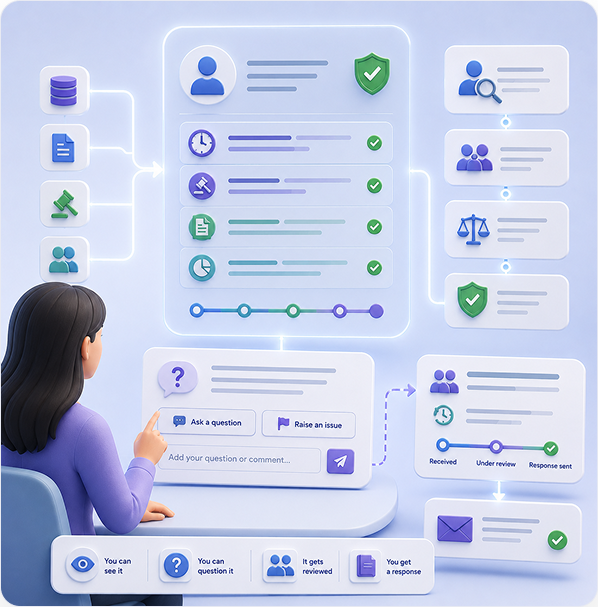
A worker's own record
One synthetic record in a state that needs attention — because a record that is already approved demonstrates nothing about how a worker is treated when something is wrong.
A required project reference is missing from this record, so it needs context before review can complete. This is a missing detail — it is not a finding about you, and it does not affect any other record.
Next decision: unit reviewer, Field Services North · not an automated decision
- Source
- Site terminal check-in and check-out
- Recorded
- Check-in 06:58, check-out 14:12, both received at the time
- Freshness
- Current — no delay affecting this record
- Known limitation
- The site register feed was delayed on this date, so project references were not attached automatically
The delay is a system condition, not a worker condition. It explains why the reference is absent.
- Policy used
- Field North Working Time, version 3 — the version effective on 6 August
- Plain explanation
- Your shift was within the standard threshold and your break met the minimum for a shift of this length, so it classified as a standard field shift.
- Newer policy
- A newer policy version exists. This record used version 3 and was not reclassified under it.
This explains how the record was categorized. It is not legal advice and does not state any pay entitlement.
You can add context, request a correction, see who reviewed it and why, follow the status, and escalate if you disagree with the outcome. Using any of these does not waive a privacy, grievance, appeal, legal, or contractual right — and no action here is required before you can ask a question.
Requesting a correction
Before submitting, a worker sees exactly what will be shared and with whom. Nothing is sent quietly, and a draft can be saved without submitting.
The flow shows
- Which field is affected, and its current value
- The proposed value or context being added
- A sharing preview — who will see this and what they will see
- The option to save a draft rather than submit
- Confirmation of what happens next, and who decides
“Prove that you worked.” No correction flow demands justification of a person's honesty, and none frames a request as a dispute or a complaint. A request is a request.
Ten correction states
Including two that a worker deserves to see named plainly.
“No change approved” and “Partially accepted”
Both are real outcomes, and both are stated neutrally with the reviewer's reason. Neither is “your claim was rejected” or “excuse denied” — a reviewer deciding the record was already correct is a legitimate result, and it does not imply the worker was wrong to ask.
Every outcome shows the authorized role that decided, the reason, any conditions, the resulting version, and the escalation route if the worker disagrees.
What an acknowledgement means
This is the single most abusable control in a worker-facing product. Where acknowledgement is enabled, the interface must say exactly what it means — and exactly what it does not.
“Acknowledged: you have seen this notice.”
That is the default and only meaning. It is stated on the control itself, not buried in a policy.
It means
- You have seen this notice or record
- The organization can show the notice reached you
It never silently means
- Consent
- Agreement with the record
- Admission of anything
- Waiver of any right
- Withdrawal of a correction request
- Acceptance of a consequential decision
Generated
A notice was created for an event.
Not yet sent to anyone.
Sent & delivered
Handed to a channel, and confirmed where the channel reports it.
Delivery is not reading.
Acknowledged
The worker confirmed they have seen it, where the feature is configured.
Seeing is not agreeing.
Failed
Delivery did not succeed. Explicit and owned by the organization.
A failed notice never counts against the worker.
The words a worker actually reads
Left column is what a workforce product usually says. Right column is what this one says instead. Microcopy is where dignity is either preserved or lost.
| Prohibited | Required |
|---|---|
| Suspicious / failed / noncompliant worker | Needs context |
| Under investigation | Pending review |
| Worker disputed the system | Correction requested |
| Your claim was rejected | No change approved |
| You were absent / did not work | The source is unavailable, so this record needs review |
| Prove that you worked | Request a correction or provide context |
| AI decided · system verdict | Your request was reviewed by an authorized role |
| Current policy replaces the old rule | A newer policy exists; this record used version 3 |
| You accept this record / waive further review | Acknowledged: you have seen this notice |
| Payroll corrected | Downstream update pending |
| Hidden evidence proves the outcome | Some details are restricted for privacy or security |
| Contact Sales for worker support | Contact Help, Privacy, or Accessibility |
“Under investigation” is permitted only where an actual authorized investigation exists. “Payroll corrected” is permitted only where target acceptance and reconciliation are genuinely confirmed. Neither is a default label.
Twelve independent state dimensions
Do not collapse record truth, correction workflow, review, source health, notification, sync, permission, downstream, support, and accessibility into one ambiguous status chip. A worker seeing a single amber dot learns nothing actionable.
Record lifecycle
Source received · classified · review required · approved · corrected or superseded · retention-limited.
What the record itself is.
Worker action
No action · review available · context requested · correction draft · submitted · acknowledgement available · escalation available.
What the worker can do right now.
Correction
None · draft · submitted · withdrawn · information requested · accepted · partially accepted · no change approved · superseded · reopened.
Separate from review state.
Review
Unassigned · assigned · pending · information requested · decision recorded · escalated · reassigned · closed · reopened.
Who holds it, not what they concluded.
Source quality
Current · delayed · stale · missing · unavailable · conflicting · imported · partial · unknown.
A system condition, never a worker condition.
Policy / evaluation
Applicable · historical · superseded · missing · conflicting · revalidation required · restricted.
Historical stays historical.
Notification
Not required · generated · sent · delivered where known · failed · corrected · acknowledged where configured.
Four separate facts, not one.
Sync
Online · saved draft · offline · pending sync · synced · failed · unknown result · conflict.
A record never silently disappears.
Permission
Allowed · restricted field · action unavailable · permission denied · role changed · session expired.
Server-checked, and explained when it blocks.
Downstream
Not applicable · not released · release pending · sent · target received · reconciled · rejected · unknown.
Sent is not received is not reconciled.
Support
No case · help viewed · support requested · response pending · resolved · escalation required.
A worker can always reach a person.
Accessibility alternative
Standard flow available · alternative requested · alternative provided · barrier unresolved.
An unresolved barrier is visible, not hidden.
What is recorded, and who decides
A worker-facing record is only trustworthy if the collection boundary and the decision boundary are both legible from inside it.
Recorded
Time events, work or project context you enter, breaks, your comments and correction requests, and disclosed authentication and audit events.
Never collected
Screenshots, keystroke content, URL history, application names, clipboard data — and no individual productivity score, at any tier or configuration.
Who decides
Deterministic rules organize configured context. Authorized people decide consequential outcomes. There is no AI verdict and no system judgment.
Getting help
Help Center, Privacy, and Accessibility routes — plus an accessible alternative if the standard flow is a barrier. Never a sales route.
Downstream and payroll boundary
CurrentObjective: never let a worker read “corrected” as “paid.”
- Record vs payroll
- ZoikoTime may prepare, approve, and export governed time records. It does not claim to perform gross-to-net payroll.
- Corrected vs delivered
- A corrected record is not the same as a downstream system receiving the update
- Delivered vs reconciled
- A receipt is not proof the target accepted the expected value
- Worker-visible wording
- “Downstream update pending” — never “payroll corrected” unless acceptance and reconciliation are genuinely confirmed
Professional boundary: no worker-facing message declares statutory pay entitlement, legal compliance, or an employment-law conclusion. Technical identifiers, secrets, and system topology stay hidden.
Errors, cutoffs & no coercion
CurrentObjective: keep urgency honest and blame absent.
- External errors
- Shown as a system or integration state. Blame is never assigned to the worker.
- Missing source
- Missing calendar, access, device, or integration context is not automatic evidence of absence or non-work
- Cutoff risk
- Shown where configured — but it never bypasses required review, notice, or approval
- No coercion
- A deadline never pressures a worker into a response, and no interface makes accepting faster than asking
Limitations: downstream detail appears only where it is understandable, permitted, and useful to the worker. Where it is not, the record says so rather than showing a technical state nobody can act on.
A record its subject can read, question, and challenge
See how state, source, policy explanation, correction, decision visibility, and escalation work together — without surveillance, scoring, or a demand that the worker accept anything unexplained.
Get Demo
Worker record questions
A role-appropriate view of their own record: the recorded time or attendance context, current state, source summary, applicable policy explanation, review status, correction history, and the available next action — plus who is responsible for the next decision. Exact fields depend on the organization's configuration and applicable law.