
Zoiko Sema
Governed communication.
- Meetings and messaging
- Channels and spaces
- Decisions and actions
- Workspace administration
- Approved AI-generated outputs
Map approved Zoiko Sema workspaces to ZoikoTime teams or organizational units, apply roles, permissions, privacy modes, policy scope, and jurisdiction controls — then review connection health and approved operational context.
 OptionalWorkspace-scopedRole-controlledAudit-ready
Zoiko Sema and ZoikoTime licensing, availability, setup, context scope, direction, and implementation vary by plan, contract, configuration, region, and product status.

Nothing is active yet
Two workspaces are excluded by policy and will never map. No exchange occurs until eligibility, mapping, governance, authorization, testing, and acceptance are all complete. Illustrative interface — all values synthetic.
Zoiko Sema and ZoikoTime are independent products that organizations may connect through an optional, customer-configured integration. Authorized administrators map approved Sema workspaces to ZoikoTime organizational scopes, define permitted context categories, roles, privacy modes, policy and jurisdiction treatment, test the connection, and approve activation. Communication context remains governed and reviewable — it does not automatically become time worked, payroll truth, performance evidence, discipline, legal status, or compliance.
Governed communication.
Explicitly configured.
Workforce Truth Infrastructure.
Independence rule
Zoiko Sema remains a complete communication platform without ZoikoTime. ZoikoTime remains complete Workforce Truth Infrastructure without Zoiko Sema. Neither is a feature hidden inside the other, and the connection between them is optional and separately qualified.
The Locked Connection Model
Three steps, in this order, always. There is no configuration in which context reaches a workforce record without passing through all three.
An authorized administrator selects which Sema workspaces connect, and to which ZoikoTime organizational scope. Nothing is mapped by default.
Explicit selection
Workspace, owner, destination unit, effective dates, ownership record.
Unmapped means outside
An unmapped workspace is not connected in any sense — not partially, not for metadata.
Duplicates resolved
Overlapping or ambiguous mappings must be resolved before activation.
Related
Direction and method are not claimed here. One-way or two-way sync, real-time delivery, APIs, webhooks, batch transfer, specific fields, latency, and providers are stated only where validated for your configuration. This page describes governance, not a transport guarantee.
Availability, Licensing & Eligibility
The integration is a separately qualified capability. Having both products does not mean the bridge is available to you.
| Dependency | Must be confirmed |
|---|---|
| Product subscriptions | Both products, separately licensed |
| Plan & contract | Integration eligibility under your current agreement |
| Enterprise setup | Implementation scope and support model |
| Region & product status | Current availability for your region and version |
| Administrator authority | Named eligible roles on both sides |
| Governance readiness | Policy, privacy, legal, and accessibility review complete |
Check current Pricing or request enterprise evaluation. Nothing on this page should be read as confirming availability for your organization.
Role-Based Entry Points
Workspace eligibility, ownership, and what leaves a workspace.
Destination scopes, policy version, review owners, retention.
What arrives for review, and what it does not establish.
Service identity, least privilege, credential custody, revocation.
Notices, source visibility, correction and support routes.
Licensing, implementation, evidence, and enterprise evaluation.
Workspace & Organizational Mapping
Selecting a mapping opens its full record: source, destination, purpose, scope, policy, privacy, owner, test evidence, and change history.
MAP-0114 · version 2 · effective 01 Sep 2026
Mapped · awaiting test
Source
Destination
Purpose & scope
Governance
Authority
Test evidence
Notices
What this mapping does not do
It does not export a communication stream, and it does not make meeting context into hours worked. It permits a defined category to be reviewed by a named person.
Mapping states: Draft · Mapping incomplete · Mapped · Test pending · Test failed · Accepted · Active · Paused · Excluded · Superseded · Retired.
Context Scope Registry
Each category carries a purpose, direction, sensitivity, retention, and visibility. A category absent from the registry is excluded by definition.
| Context category | Registry state |
|---|---|
| Meeting context — occurrence, scope, owner | Approved |
| Decisions recorded in an approved space | Approved |
| Actions and owners from an approved space | Approved |
| Approved AI-generated summary, as reviewable draft | Conditional — human review required |
| Message content and full communication streams | Excluded |
| File content and attachments | Excluded |
| User activity monitoring of any kind | Prohibited |
No universal export
Not every message, meeting, file, user activity record, or AI output is shared with ZoikoTime. Unmapped workspaces and unapproved or excluded categories remain outside the connection entirely — there is no partial or metadata-only leakage from an unmapped workspace.
Precise categories, fields, direction, timing, retention, and visibility must come from your current configuration and documentation rather than from this page. Publishing a field list we cannot guarantee for your deployment would be a claim, not information.
Governance, Privacy Modes & Jurisdiction
Only authorized administrators select workspaces, mappings, context categories, roles, privacy modes, policy scope, jurisdiction treatment, and retention. No prompt, request, or integration behavior expands that.
No screenshots, keystroke content, URL history, application-name monitoring, or clipboard collection under any tier or configuration.
Least context necessary for the stated purpose.
Narrow role visibility with review required.
Unit-level context only, no individual attribution.
Nothing reaches a workflow before human approval.
The workspace or category never connects.
Administrator-configuredWhich workspaces map, and to which scopesWhich context categories are permittedPrivacy mode per mappingPolicy version, jurisdiction treatment, retentionNotices, review requirements, and audit settings Excluded by policy, typicallyConfidential and legal spacesExecutive and HR spacesSecurity and regulated spacesExternally attended spaces
Jurisdiction and data-location treatment is qualified, never asserted. See Data Location & Residency.
Controlled Setup & Authorization
Deliberately slow. An integration that can be switched on in an afternoon is an integration nobody reviewed.
Stage 01
Products, contracts, versions, environments, ownership, roles, support path, readiness.
Stage 02
Sema owner, ZoikoTime owner, integration admin, security/privacy/legal reviewers, business owner, final approver.
Stage 03
Business purpose, mapped organizations, categories, permitted and prohibited uses, acceptance criteria.
Stage 04
Workspaces to scopes, duplicates resolved, effective dates, ownership recorded.
Stage 05
Roles, privacy modes, policy versions, jurisdiction, retention, notices, exclusions, audit.
Stage 06
Approved method, service identity, least privilege, credential custody, expiry, revocation.
Stage 07
Non-production or synthetic data, sample mappings, denied and excluded cases, error and retry.
Stage 08
Product, business, security, privacy, legal, accessibility, support, and operational sign-off.
Stage 09
Scheduled activation, notices confirmed, first exchanges monitored, rollback preserved.
Stage 10
Health, exceptions, questions, audit evidence, mappings, policy, versions, expansion readiness.
Acceptance requires validating denied cases, excluded categories, permission errors, and retry behavior — not only the happy path. A test that only proves success has not tested the governance.
Test data is approved non-production, synthetic, or controlled. Live worker records are never used to validate a new mapping.
Review Before Sync & Human Authority
The integration never determines
Time worked · attendance · breaks · payroll outcomes · performance · misconduct · discipline · employment status · legal status · compliance. It may route context for review. Authorized humans decide, under ZoikoTime policy, with correction and escalation available.
Any ZoikoTime classification downstream remains deterministic, policy-bound, jurisdiction-aware, reviewable — and is never branded as AI.
Connection Health & Change History
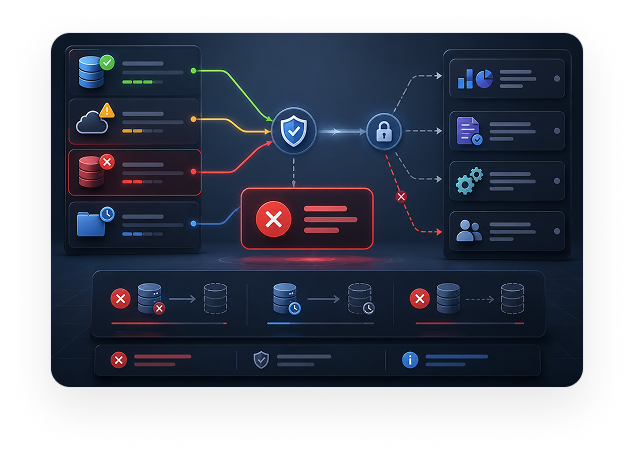
Exceptions, Retry, Quarantine & Reconciliation
Uncertain context is contained rather than passed along. Quarantine exists so that a failure cannot become a workforce record by default.
| Exception | Affected mapping | Attempts | Owner | Participant impact | State |
|---|---|---|---|---|---|
| Authorization expired | Service Desk | 3 | IT & security | None — nothing exchanged | Open |
| Mapping conflict | Project Atlas | — | Integration admin | None — not active | Awaiting correction |
| Retention conflict | Field Ops North | 1 | Privacy | Notice update required | Quarantined |
Exception queue, synthetic. Diagnostics are sensitive-data-safe; no message content, credential, or worker record appears in an error detail.
Prevents uncertain context from reaching downstream workflows while preserving source, reason, owner, review, and expiry. Nothing is discarded, and nothing proceeds.
Compares source, bridge record, destination status, version, review outcome, downstream effect, and corrective action. Conflicts are never silently overwritten.
Requires resolved cause, retry or reconciliation result, affected items reviewed, participant communication where required, complete evidence, linked support reference, prevention logged, and owner sign-off.
Meeting-to-Work Context
Approved meeting context — occurrence, scope, owner, recorded decisions, actions, and follow-ups — may support review. Its limitations travel with it.
Meeting presence is not time worked
Meeting presence or duration is context, not automatic time, attendance, payroll, performance, or compliance truth. ZoikoTime rules, review, correction, and human approval remain authoritative — a calendar entry has never been evidence of work performed.
Structured communication outcomes — a recorded decision, an assigned action, a named owner, a follow-up — carry their workspace scope with them. Unstructured discussion does not transfer.
Governed AI-Generated Outputs
 AI-generated
Product, version, and model information appear only when approved. A reviewer must verify source, accuracy, completeness, attribution, context, sensitivity, permitted purpose, and destination effect before approval.
Prohibited use of any AI output
No AI-generated output may automatically determine hours, attendance, breaks, payroll, performance, misconduct, discipline, employment status, legal status, or compliance. If source content, AI output, policy, or a reviewer decision changes, downstream context is re-evaluated and versioned.
Worker & Participant Transparency
Approved notices where the integration affects a worker-facing record or workflow, issued before first exchange.
Which workspace, which category, which purpose, and which policy version applied.
A defined route with human review, and escalation where a correction is declined.
A named route for questions about the integration itself, not only about a record.
Manager, Reviewer & Leadership Experience
Audit Evidence & Governed Exports
Exports are governed, scoped, and audited. Audit evidence supports review — it is not an audit opinion, and it does not establish legal admissibility.
Security, Privacy, AI Governance & Trust
Entry point for assurance evidence.
Identity, access, encryption, logging, incidents.
Categories, purposes, retention, rights.
Approved scope, prohibited uses, authority classes.
Where decision authority sits and stays.
Storage, processing, access, transfers — separately.
Tested scope, methods, known limitations.
Authoritative current operational state.
Jurisdiction, Residency, Retention & Lifecycle
Data location, transfer, retention, deletion, and retirement for the integration are qualified against your contract and configuration. This page makes no residency guarantee for any region.
Retirement covers disabling a mapping, pausing exchange, deleting or retaining prior context per schedule, and preserving audit history. Decommissioning the bridge does not delete records already created in ZoikoTime under policy.
No certification, compliance, data-residency, security, retention, customer, productivity, ROI, accuracy, or performance claim appears on this page. Where a claim would require evidence we do not currently hold, the claim is absent rather than hedged.
Implementation, Pilot, Launch & Expansion
Phase 01
Output
Eligibility confirmed, authority named, purpose and acceptance criteria documented.
Phase 02
Output
One or two mappings, full governance, tested denied cases, participant notices live.
Phase 03
Output
Scheduled activation, monitored first exchanges, rollback preserved, support runbook active.
Phase 04
Output
Health and exception review, audit evidence, expansion only after stabilization.
There is no universal implementation duration. Timing depends on scope, workspaces, governance review, jurisdictions, pilot outcomes, and support model.
Commercial & Enterprise Evaluation
No customer names, logos, counts, quotes, metrics, or case studies appear here, because none has been verified and approved for this integration. This is an intentional empty state rather than an omission — when verified evidence exists, it will appear with its scope and date.
Pause, disable, and decommission are supported operations with their own evidence and notice requirements — not hidden settings.
Optional by Design
See how an optional, customer-configured bridge can route approved Zoiko Sema context into reviewable ZoikoTime operations — with explicit mapping, governance, human review, and audit history at every step.
Explore ZoikoTime Trust Center

Direct Answers
They are independent products connected through an optional, customer-configured bridge using approved workspace mapping, governance controls, context scope, human review, and audit history. Each remains fully useful without the other.