
Connect approved
communication
context to
reviewable
workforce
operations
Map approved Zoiko Sema workspaces to ZoikoTime teams or organizational units, apply roles, permissions, privacy modes, policy scope, and jurisdiction controls, then review connection health and approved operational context.
Optional, customer-configured, workspace-scoped, role-controlled, privacy-respecting, and audit-ready.
Zoiko Sema and ZoikoTime licensing, availability, setup, context scope, direction, and implementation vary by plan, contract, configuration, region, and product status.

What this connection is not
Not a universal export. Unmapped workspaces and unapproved context stay outside the connection. Communication context never becomes time worked, payroll truth, performance evidence, discipline, legal status, or compliance on its own.
How do Zoiko Sema and ZoikoTime work
together?
Zoiko Sema and ZoikoTime are independent products that organizations may connect through an optional, customer-configured integration. Authorized administrators map approved Sema workspaces to ZoikoTime organizational scopes, define permitted context categories, roles, privacy modes, policy and jurisdiction treatment, test the connection, and approve activation. Communication context remains governed and reviewable; it does not automatically become time worked, payroll truth, performance evidence, discipline, legal status, or compliance.
Zoiko Sema
Governed communication.
- Meetings and messaging
- Channels and spaces
- Decisions and actions
- Workspace administration
- Approved AI-generated outputs
Governed Bridge
Customer-configured, workspace-scoped.
- Explicit workspace mapping
- Role permissions and privacy modes
- Approved context scope
- Policy and jurisdiction
- Review-before-sync, health, audit
ZoikoTime
Workforce Truth Infrastructure.
- Reviewable workforce records
- Deterministic policy application
- Human review
- Evidence Ledger history
- Approved reporting and workflows
Zoiko Sema remains useful without ZoikoTime. ZoikoTime remains useful without Zoiko Sema. The connection is optional and separately qualified—neither product is a feature hidden inside the other.
Map → Govern → Review
Three steps, each with an owner and a control. No step completes because someone scrolled past it.
Map approved workspaces
What happens
Authorized administrators select which Sema workspaces may connect and map them to approved ZoikoTime teams, departments, projects, or organizational units.
Every mapping carries
Purpose, owner, scope, effective date, and status.
Apply governance
What happens
Roles, permissions, privacy modes, context categories, policy versions, jurisdiction treatment, retention, notices, exclusions, review requirements, and audit controls determine what is available and to whom.
Control
Configuration is explicit — nothing is enabled by default.
Review operational context
What happens
Authorized users review connection health, source context, policy alignment, exceptions, human-reviewed actions or decisions, and approved organization-level reporting.
Boundary
Review does not create automatic time, payroll, performance, disciplinary, legal, or compliance outcomes.
Three Distinct Layers, With the Boundary
Made Explicit
The bridge is a control surface, not a pipe. Every exchange carries a mapping version, a policy version, an authorization, a test result, and an approver.
| Layer | Contents | Control Evidence |
|---|---|---|
| Zoiko Sema source | Approved workspace-scoped meetings and recaps, channels and spaces, structured decisions and actions, workspace administration context, governed AI-generated outputs. | Exact categories require registry approval. |
| Governed bridge | Workspace mapping, organization mapping, purpose, context scope, role permissions, privacy mode, policy and jurisdiction, review-before-sync, service identity, test and acceptance, status, exception handling, audit history. | Mapping version, policy version, authorization, test result, approver, effective date, last successful exchange, exceptions, last review. |
| ZoikoTime destination | Approved workforce context, policy alignment, review queues, evidence references, organization-level reporting availability. | Downstream workflows only after separate ZoikoTime controls. |
Zoiko Sema source
Contents
Approved workspace-scoped meetings and recaps, channels and spaces, structured decisions and actions, workspace administration context, governed AI-generated outputs.
Control Evidence
Exact categories require registry approval.
Governed bridge
Contents
Workspace mapping, organization mapping, purpose, context scope, role permissions, privacy mode, policy and jurisdiction, review-before-sync, service identity, test and acceptance, status, exception handling, audit history.
Control Evidence
Mapping version, policy version, authorization, test result, approver, effective date, last successful exchange, exceptions, last review.
ZoikoTime destination
Contents
Approved workforce context, policy alignment, review queues, evidence references, organization-level reporting availability.
Control Evidence
Downstream workflows only after separate ZoikoTime controls.
This page must not imply
- ×Every message or meeting is exported
- ×Hidden collection or unrestricted access
- ×Continuous employee monitoring
- ×Automatic time creation or behavior scoring
- ×Universal two-way sync or instantaneous delivery
What is actually stated
- ✓Only mapped workspaces participate
- ✓Only approved context categories move or are referenced
- ✓Direction, timing, and method appear only from a validated contract
- ✓Human review sits between context and consequence
Nothing Here Implies
You Already Have It
Zoiko Sema and ZoikoTime availability, licensing, enterprise setup, implementation, region, environment, product version, and support requirements vary. Eligibility is evaluated, not assumed.
Sema organization and workspace ownership
ZoikoTime organization access and approved subscriptions
Compatible versions and administrative authority
Security and privacy review, and implementation readiness
Commercial separation: ZoikoTime is not included in Zoiko Sema pricing, and Zoiko Sema is not included in ZoikoTime pricing. Current inclusion comes from approved Pricing and commercial sources only.
Eligibility registry, synthetic. Each row carries an owner, evidence reference, and last-reviewed date.
Where a prerequisite is missing we explain which one, and route to Product Overview, Documentation, Trust, Pricing, Sales, or Support. There are no coming-soon promises.
Role-Based Entry Points
Seven Roles, Four Separate Authorities
Workspace ownership, administrative role, reviewer authority, and workforce decision authority are separate things. Effective access determines the actual action.
Sema workspace administrator
Select approved workspaces, confirm owners, propose context scope, review privacy and policy requirements, initiate tests, and see connection status according to permission.
Boundary — Proposing a mapping is not approving one. Activation requires ZoikoTime-side authority.
Workspace Mapping
Administrators Choose Which
Workspaces May Connect
Selection criteria are explicit: business purpose, approved owner, eligible workspace type, sensitivity classification, external participants, policy group, jurisdiction, retention, and source-data readiness.
Mapping Action
- Propose connection
- Select ZoikoTime destination
- Define purpose and scope
- Choose governance profile
- Assign reviewers, test, submit for approval
Impact Panel
- Participants potentially affected
- Workflows using the mapping
- Context categories and policies
- Retention, notices, dependencies
- Required approvers
Sensitive Workspace Treatment
Legal, executive, HR, security, medical, confidential, regulated, or other protected spaces are excluded or separately controlled according to approved policy. Automatic categories are never published without validation.
No Silent Bulk Enablement
Bulk proposal is available only when every workspace displays its scope, differences, conflicts, approvals, and partial-failure handling.

ZoikoTime Organizational Mapping
An Administrative Relationship,
Not an Employment One
A mapping connects a workspace to an approved ZoikoTime team, department, unit, project, or entity scope. Only supported object types are published.
Mapping Fields
- Sema workspace, destination type and ID
- Purpose, effective date, review date
- Owner, reviewer, policy profile
- Context scope, status, version
Relationship Types
- One-to-one, one-to-many, many-to-one
- Inherited or manual exception
- Only when supported and documented
Conflict Checks
- Destination already mapped
- Overlapping scope, ownership mismatch
- Effective-date or jurisdiction conflict
- Policy incompatibility, archived object, duplicate
Organizational mapping does not establish employment status, payroll group, manager authority, or legal entity. Those are governed separately in ZoikoTime, and a mapping never creates them by implication.
Preview shows which approved context categories and workflows would be affected. It never previews participant-level content. Changing a destination requires impact analysis, testing, approval, effective date, notice review, rollback, and audit.
Context Scope Registry
References and Structured Fields —
Not Message Bodies
Content minimization is the default. The registry prefers references, identifiers, approved structured fields, and source links over copying transcripts, recordings, files, or free text. Any content transfer requires explicit validation.
| Category Family | Permitted Use | Status |
|---|---|---|
| Meeting / recap reference | Attach a reviewed reference to a mapped workflow. | Approved |
| Channel / space reference | Scope and policy context for coordination. | Approved |
| Structured decision | Decision reference with owner and source link. | Approved |
| Assigned action / follow-up | Action, owner, due date, status. | Approved |
| Workspace policy / configuration context | Governance alignment checks. | Review required |
| Approved AI-generated summary or action | Human-reviewed only, labelled, source-referenced. | Review required |
| Connection and audit metadata | Health, evidence, and change history. | Approved |
| Full message bodies, transcripts, recordings, files | Not a default category. Requires explicit validation. | Not approved |
Prohibited Use of Any Category
No behavior monitoring, productivity ranking, sentiment scoring, personality inference, misconduct accusation, hidden employee observation, or automatic consequential decision.
Each category carries twenty-one required metadata fields, including purpose, permitted and prohibited use, sensitivity, participant notice, worker visibility, reviewer, correction path, retention, jurisdiction, owner, evidence, version, and review date. Where exact direction or timing is unverified, the registry displays "Subject to approved implementation" rather than fabricating behavior. External participant and guest data is excluded or separately governed.
Governance, Privacy Modes & Jurisdiction
Five Conceptual Privacy Modes
Exact behavior is product-validated. These are the conceptual modes a governance profile may apply per mapping and per category.
Excluded
The workspace or category does not participate at all.
Metadata / Reference Only
A source reference and identifier — no content.
Approved Structured Context
Validated structured fields for a documented purpose.
Review Required
Nothing reaches a workflow without human approval.
Paused
Configuration preserved, exchange stopped.
Governance Profile
Name, purpose, mapped workspaces and units, policy version, context categories, permitted roles, review requirement, effective period, owner, approvers, and status.
Role Controls
Who may configure, approve, test, view source references, review context, attach context, export evidence, pause, resume, or retire.
Jurisdiction Controls
Organization scope, participant location context, policy and legal review status, notice requirements, restrictions, transfer qualification, and professional-review owner.
Retention
Source, transferred or reference, evidence, exception retention, deletion or archival behavior, legal-hold conflict, owner, and review date.
Notice Preview
Connected by your organization, purpose, source, who may access, retention summary, rights, support route, and policy update date.
Human Authority
Governance can route context and require review. It cannot delegate consequential employment, payroll, legal, compliance, disciplinary, or performance decisions to an integration or AI.
Controlled Setup & Authorization
Ten Stages to an Authorized Connection
Setup progression requires product-side validation. It cannot advance from marketing interaction or scroll position.
Stage 01
Confirm Eligibility
Covers
- • Products, contracts, versions, environments.
- • Organization ownership and readiness.
- • Administrator roles and permissions.
- • Support path validation.
Stage 02
Establish Authority
Covers
- • Sema owner and ZoikoTime owner.
- • Integration administrator assignment.
- • Security, privacy and legal reviewers.
- • Business owner, support owner and final approver.
Stage 03
Define Purpose & Scope
Covers
- • Business purpose and mapped organizations.
- • Mapped workspaces and context categories.
- • Permitted and prohibited uses.
- • Acceptance criteria.
Stage 04
Design Mapping
Covers
- • Workspace-to-scope mapping.
- • Duplicate and overlap resolution.
- • Effective dates.
- • Recorded ownership.
Stage 05
Configure Governance
Covers
- • Roles and permissions.
- • Privacy modes and policy versions.
- • Jurisdiction, retention and notices.
- • Review-before-sync, exclusions and audit.
Stage 06
Authorize Connection
Covers
- • Approved authorization method.
- • Service identity and least privilege.
- • Credential custody, expiration and revocation.
- • Method published only after validation.
Stage 07
Test Safely
Covers
- • Approved non-production or synthetic data.
- • Sample mappings and excluded cases.
- • Error handling and retry validation.
- • Evidence capture and verification.
Stage 08
Review & Accept
Covers
- • Business, product and operational sign-off.
- • Security, privacy and legal review.
- • Accessibility verification.
- • Acceptance criteria approval.
Stage 09
Activate & Communicate
Covers
- • Scheduled activation.
- • Participant notices and documentation.
- • Support readiness and monitoring.
- • Rollback plan and announced status.
Stage 10
Stabilize & Govern Change
Covers
- • Health monitoring and exceptions.
- • Audit evidence and policy reviews.
- • Mapping and version governance.
- • Support and expansion readiness.
Setup Output
Implementation plan, approved mapping, governance profile, test evidence, acceptance record, activation record, rollback plan, support runbook, and review schedule.
Testing, Acceptance & Safe Activation
Fifteen Test Families —
Including the Ones That
Should Fail
A test suite that only proves the happy path proves nothing. Denial and exclusion cases are release-blocking.
- Authorized mapping · unauthorized workspace
- Excluded or sensitive space · permitted category · prohibited category
- Missing permission · guest or external participant
- Policy mismatch · retention conflict · duplicate or overlap
- Unavailable destination · retry and reconciliation
- Pause and rollback · accessibility · notice visibility
Production Protection
Synthetic or approved test data only. No real worker communication content appears in public demonstrations or generic test environments.
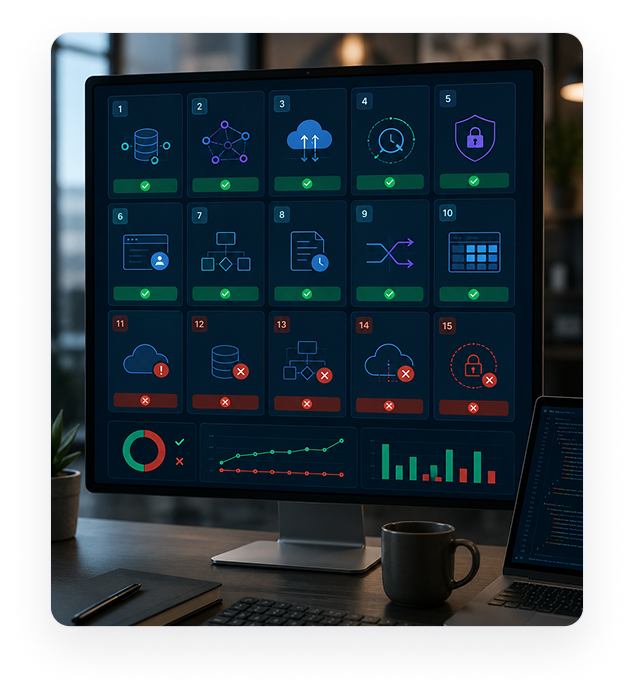
Review Before Sync & Human Authority
A Human Sits Between Context
and Consequence
The review queue is where communication context either becomes reviewed operational context, or does not.
| Context type | Sema workspace | Mapped scope | Origin | Reviewer | Status |
|---|---|---|---|---|---|
| Assigned action | Field Ops | Field Services · North | Manual | R. Adeyemi | Pending review |
| Structured decision | Harbour Project | Projects · Harbour | Manual | A. Weber | Approved |
| Meeting recap reference | Service Desk | Service Desk · EMEA | AI-generated | L. Marín | Needs verification |
| Follow-up suggestion | Field Ops | Field Services · North | AI-generated | Unassigned | Conflict — policy mismatch |
Assigned action
Pending reviewStructured decision
ApprovedMeeting recap reference
Needs verificationFollow-up suggestion
Conflict — policy mismatchReview queue, synthetic. Generated items are labelled and never auto-approved.
Permitted reviewer actions
- ✓Approve attachment or use
- ✓Approve edited structured context
- ✓Request clarification, exclude, or reject
- ✓Reassign, escalate, or pause the mapping
Prohibited automation
- ✕No automatic declaration of time worked or attendance correctness
- ✕No automatic break violation or payroll treatment
- ✕No automatic misconduct, discipline, or performance finding
- ✕No automatic legal status or compliance conclusion
Decision evidence records actor, role, effective access, action, reason, before and after, source, policy, timestamp, audit reference, and downstream result. Where context contributes to a worker-facing record, that record shows source and review status and follows approved correction rights.
Nine Statuses, Each With
a Definition and an Owner
Freshness shows an exact timestamp and time zone with its source. We do not write "live" or "real-time" unless evidence supports it.
The timeline records authorization, testing, activation, mapping changes, policy changes, permission updates, context-category changes, pause/resume events, retries, reconciliation, support events, and retirement.
Every history record keeps before and after values, actor or service identity, role, reason, approver, effective date, version, and linked test results.
Health Cards
- Active mappings and approved categories
- Last successful exchange or test
- Queued items and exceptions
- Policy review due and notice status
Mapping Health Table
- Workspace and destination
- Configuration version and current status
- Last attempted and last successful activity
- Exception count, owner and next review
Alerts
- Severity, affected scope and first observed
- Current impact, owner and remediation
- Update time, status and support reference
No worker-level exposure in any alert.
Freshness Honesty
An exact timestamp with time zone and source is more useful than a green dot labelled "live". If the last successful exchange happened 41 hours ago, that is exactly what the panel reports.
Exceptions, Retry, Quarantine & Reconciliation
Fifteen Exception Types,
None of Them Silent
Quarantine prevents uncertain context from reaching downstream workflows while preserving source, reason, owner, review, and expiry.
| Exception Type | Typical Action |
|---|---|
Authorization expired · permission denied | Restore permission or re-authorize. Access is never broadened to complete an exchange. |
Workspace or destination missing | Correct mapping, or pause the affected mapping. |
Mapping conflict · duplicate · out-of-order | Reconcile against source, bridge record, and destination status. |
Excluded category · policy or jurisdiction mismatch | Request review or exclude with recorded reason. |
Retention conflict | Route to authorized review. No automatic legal determination. |
Source or destination unavailable | Retry safely, or quarantine pending review. |
Unsupported version | Block and route to update path. |
Review overdue · test or acceptance expired · notice outdated | Escalate to owner. Expired evidence is not reused. |
Exception Type
Authorization expired · permission denied
Typical Action
Restore permission or re-authorize. Access is never broadened to complete an exchange.
Exception Type
Workspace or destination missing
Typical Action
Correct mapping, or pause the affected mapping.
Exception Type
Mapping conflict · duplicate · out-of-order
Typical Action
Reconcile against source, bridge record, and destination status.
Exception Type
Excluded category · policy or jurisdiction mismatch
Typical Action
Request review or exclude with recorded reason.
Exception Type
Retention conflict
Typical Action
Route to authorized review. No automatic legal determination.
Exception Type
Source or destination unavailable
Typical Action
Retry safely, or quarantine pending review.
Exception Type
Unsupported version
Typical Action
Block and route to update path.
Exception Type
Review overdue · test or acceptance expired · notice outdated
Typical Action
Escalate to owner. Expired evidence is not reused.
Reconciliation
Reconciliation compares source, bridge record, destination status, version, review outcome, downstream effect, and corrective action. Conflicts are never silently overwritten.
Closure requires the cause resolved, retry or reconciliation result, affected items reviewed, worker or participant communication where required, complete evidence, linked support or incident, logged prevention change, and an owner sign-off.
Meeting-to-Work Context · Channels, Spaces, Decisions & Actions
A Meeting Is Context.
It Is Not a Timesheet.
An approved meeting reference, decision, or assigned action may attach to a mapped ZoikoTime workflow when purpose, policy, permission, privacy, and human review all allow.
Allowed pattern
- ✓Transfer or reference only the validated structured context required for the approved purpose.
- ✓Decision reference, assigned action, owner, due date, status, source link.
- ✓Retain source-system link and provenance where supported.
- ✓Author or approver shown where permitted.
Excluded pattern
- ✕Blanket export of messages, reactions, or edits.
- ✕Files, search history, typing or activity indicators.
- ✕Communication volume or user behavior.
- ✕Entire message histories displayed by default.
Not sufficient alone
Meeting attendance, presence, duration, speaking time, chat activity, transcript content, or an AI recap is not proof of time worked, productivity, misconduct, performance, payroll treatment, or legal compliance.
Destination status is explicit: pending review, approved context, attached to workflow, excluded, rejected, correction requested, or superseded. When a source is edited or deleted, a decision changes, an action is reassigned, or a mapping is paused, the downstream impact is reviewed and versioned rather than quietly dropped.
Governed AI-Generated Outputs
An AI Recap Is a
Communication Artifact,
Not a Workforce Record
An approved Sema AI summary, action extraction, decision capture, recap, or follow-up suggestion may be considered for integration only when the feature, workspace, policy, permission, retention, and destination use are all validated.
Prohibited Use
No AI-generated output may automatically determine hours, attendance, breaks, payroll, performance, misconduct, discipline, employment status, legal status, or compliance.
Required label
AI-generated, with draft or review status
Source references and generated time
Retention, reviewer, edited status
Stated limitations
Product, version, or model information only when approved.
Human review
A reviewer verifies source, accuracy, completeness, attribution, context, sensitivity, permitted purpose, and destination effect before approval. Edits remain visibly human-reviewed and versioned.
Sensitive space exclusion
AI or the integration may be disabled or limited in confidential, legal, executive, HR, security, regulated, or externally attended spaces according to policy.
Change behavior
If source content, AI output, policy, or a reviewer decision changes, downstream context is re-evaluated and versioned.
Workforce Truth & Approved Context Signals
What Happens on the ZoikoTime Side
Approved context arrives or is referenced with its source, mapping, purpose, category, policy, version, review status, and authorization metadata — then goes through the same controls as any other input.
Validate
Source availability, mapping, context category, permissions, policy, jurisdiction, effective date, duplicate or conflict, review requirement, destination eligibility.
Classify where applicable
Deterministic classification uses documented policy and jurisdiction rules and stays reviewable. Communication context alone never forces a classification.
Review and approve
Worker and authorized reviewer visibility, correction, and approval apply according to the affected ZoikoTime workflow and policy.
Evidence and output
The Evidence Ledger preserves relevant source, mapping, review, changes, decisions, approvals, exceptions, and downstream package status.
Shared responsibility
Sema source quality, organization configuration, mapping, policy, human review, ZoikoTime controls, downstream systems, and professional obligations remain distinct responsibilities.
Boundary
The bridge supports context and coordination. It does not guarantee accurate payroll, legal compliance, complete communication interpretation, or the absence of disputes.
If Connected Context
Touches Your Record,
You Can See It
The notice states: connected by your organization, the products involved, mapped scope, approved purpose, context category, source, review status, who may access it, retention summary, rights and support route, and the policy version.
Record card
Context label, source product and workspace where permitted, date, relationship to the workforce record, human review status, current outcome, change history.
Correction path
Open context → review source and reason → request correction or clarification → human review → decision → updated history → escalation and support.
Restrictions
Sensitive source content may be restricted while still explaining category, purpose, decision, reviewer, and correction path where appropriate.
Accessibility and language
Plain language, accessible formats, locale and time-zone context, alternative support channels.
No Hidden Scoring
No individual productivity score, communication-volume score, sentiment score, responsiveness ranking, behavioral profile, or surveillance heatmap.
Bounded Review,
Not Broad Access
Manager / Reviewer
Assigned review queue, mapped team and workspace context, source references where permitted, conflicts, worker review status, permitted decisions, escalation, history.
Operations / HR Reviewer
Cross-workflow exceptions, policy alignment, mapping issues, correction backlog, ownership, deadlines, evidence, support — with no blanket message access.
Executive / Leadership
Approved organization-level connection health, mapped scope, policy status, workflow status, exception trends, adoption, review completion.
Source Access Is Separate
A role may see that context exists, and its category, without permission to open the Sema source. Effective access is enforced independently of the queue view.
Prohibited Metrics
Individual message count, response speed, speaking time, meeting duration ranking, sentiment, after-hours communication score, productivity score, worker leaderboard, or hidden risk score.
Leadership reporting does not authorize employment, payroll, disciplinary, performance, or legal decisions without separate evidence and a human process. Small groups and sensitive categories are aggregated or suppressed where required.
Eighteen Evidence Events,
One Field Contract
Every event carries the same fields: event ID, timestamp and time zone, actor or service identity, role and effective access, organization scope, configuration version, source and destination, action, reason, before and after, policy, evidence reference, and result.
Configuration Events
Eligibility review, authority assignment
Mapping created or changed
Governance profile or policy change
Authorization, test, acceptance, activation
Operational Events
Context received or referenced
Review, correction, decision
Exception, retry, reconciliation
Pause, resume, support, retirement
Export Controls
Purpose, scope, period, fields, redaction
Role, approval, format, retention
Delivery destination, acknowledgment, expiration
Watermark or reference where approved
Evidence can support review and audit.
It does not guarantee legal admissibility, legal compliance, complete communication meaning, payroll correctness, or a particular investigation outcome.
Delivery history tracks requested, approved, generated, delivered, acknowledged, failed, expired, and revoked — each with an owner and a support path.
Security, Privacy, AI Governance & Trust
Assurance Routes,
Not a Badge Wall
We do not publish certifications, audit reports, encryption claims, residency, uptime or compliance marks without current verified scope and approval. What we publish is where to get the evidence.
Trust Center
Entry point for all assurance material.
Security
Access, authorization, operational security.
Privacy
Purpose limitation, minimization, rights.
Anti-Surveillance
The exact invariant across every configuration.
Human-in-Command
Where authority sits and stays.
AI Governance
Approved scope and prohibited uses.
DPA & Subprocessors
Contractual data terms.
Service Status
Incidents, maintenance and deprecations.
Professional Boundary
The integration provides software and context workflows. It does not provide legal, tax, payroll, employment, immigration, benefits, disciplinary, performance, compliance, or other professional advice.
Region Boundary
Office, product, user, workspace, hosting, data and support regions are distinct. None of them may be inferred from another.
Jurisdiction, Residency, Retention & Lifecycle
The following controls define how jurisdiction, residency, retention and lifecycle events are governed throughout the platform.
| Control | Required Treatment |
|---|---|
| Jurisdiction Status | Not evaluated • Professional review required • Approved configuration • Restricted • Unavailable • Exception approved • Review expired. |
| Transfer Register | Category, source, destination, purpose, direction, location, access, safeguards, subprocessors, retention, owner and review date. Only approved public detail is published. |
| Retention Stages | Source system, bridge queue or reference, review and evidence, destination record, export, support and incident, then retirement, deletion or archive. |
| Source Deletion or Change | Does not silently erase audit history or downstream effects. Policy defines reference availability, correction, archival, reconciliation and notice. |
| Legal Hold Conflict | Routes to authorized review. The integration makes no automatic legal determination. |
| Data Minimization | Never copy more communication content than required. Prefer source references and approved structured outcomes. |
Implementation, Pilot, Launch & Expansion
Nine Phases, Ending in
Expansion or Hold
Timeline, services, scope, outcomes and availability vary by contract, readiness, complexity, configuration, jurisdiction and product status.
Phase 01
Discovery
Purpose, products, workspaces, organization structure, participants, jurisdictions, context needs, risks, support, success criteria.
Phase 02
Architecture & Governance
Mapping, categories, roles, privacy, policy, human review, notices, retention, security, data flow, evidence, support.
Phase 03
Readiness & Authority
Contracts, product versions, ownership, administrative roles, approvals, documentation, environments, support model.
Phase 04
Configuration
Mappings, governance profiles, service authorization, review queues, exceptions, evidence, reports, notices, support routes.
Phase 05
Validation
Functional, permission, privacy, security, accessibility, jurisdiction, data, error, reconciliation, rollback, support, acceptance testing.
Phase 06
Pilot
Limited approved workspaces, units, and categories. Named participants, enhanced support, feedback routes and no unapproved expansion.
Phase 07
Launch
Approved activation window, notices, training, support, monitoring, rollback, executive and operational communication.
Phase 08
Stabilization
Health, exceptions, user questions, corrections, audit, support, mapping and policy changes, release issues, adoption.
Phase 09
Expansion or Hold
An evidence-led decision to expand approved scope or to pause or retire. Both are valid outcomes.
Existing Customer Access, Support, Pause & Retirement
Authenticated Actions
Open Integration Settings, Continue Setup
View Mappings, Review Governance, Run Tests
View Health, Resolve Exceptions, View Audit
Pause, Resume, Start Retirement
Each based on effective access.
Pause Preview
Affected mappings, categories and workflows; queued and in-flight items; notices; reporting; support; restart prerequisites; approval; effective time.
Retirement Checklist
Business approval, dependency inventory
Stop new context, process or quarantine remaining
Reconcile, export evidence, revoke credentials
Archive or delete, update notices, verify downstream, final audit
Help, Documentation, Status, Accessibility, Security Reporting, and customer support never require marketing consent or a demo submission.
Commercial, Licensing & Enterprise Evaluation
Two Products, Two Subscriptions,
One Qualified Conversation
Zoiko Sema and ZoikoTime may require separate subscriptions, enterprise setup, implementation, support and contract review.
Integration Status For Your Organization
Eligibility Review Required
Evaluation Factors
Products and editions, users and workspaces
Organizations, units, context categories, environments
Regions, jurisdictions, mapping complexity
Identity and security, privacy and legal review
Implementation, support, reporting, residency requirements
Not Claimed Here
“Included,” “free,” “instant,” or “unlimited”
Real-time delivery or a fixed timeline
ROI, compliance, or outcome guarantees
Universal plan or region support
Start Free evaluates ZoikoTime generally. It does not guarantee integration access. Sales follow-up and marketing consent are separate, neither is preselected, and access to policy or support is independent of both.
Governed connection
Connect governed
communication context to
accountable workforce
operations
See how Zoiko Sema and ZoikoTime can connect approved workspaces, roles, decisions, actions, and reviewed context through explicit mapping, privacy controls, human authority, and audit evidence.
Availability, licensing, setup, context scope, direction and support vary.

Integration Questions Answered
Integrations — answered
ZoikoTime connects with leading HR, payroll, financial management, identity provider, and calendar applications through native integrations, APIs, webhooks, and automated export workflows.